
Curating Security Data for the Financial Services Industry

Security is not just an IT priority in financial services. It is the foundation of the entire business. The need to keep financial assets and information safe is why the modern financial services industry exists. Banks, insurers, payment providers, trading firms, and fintech platforms are all built on trust. Customers trust that their money is safe, that their identities are protected, and that transactions will be accurate and available when needed. A single security failure can erode that trust in an instant.
At the same time, the digital transformation of financial services has multiplied both opportunity and risk. Online banking, mobile apps, algorithmic trading platforms, crypto exchanges, digital wallets, and open banking APIs have created an always on, always connected ecosystem. Every login, transfer, trade, API call, and system interaction generates telemetry. That data is essential for detecting fraud and cyber threats, but it also creates a serious problem. The sheer volume of logs, events, and alerts can overwhelm security teams. Real threats hide in plain sight, buried under mountains of routine activity and low-value noise.
Real-World Security Risks
Security risks in the financial sector aren’t just theoretical. They have played out repeatedly in the real world because of the scale and value of the data involved. One of the biggest security failures in the North American financial ecosystem was the 2017 Equifax breach. Attackers exploited a known vulnerability in the Apache Struts web framework that had been publicly disclosed and patched months earlier. Once inside, they moved laterally through Equifax’s environment, using plaintext credentials to access sensitive databases. For nearly 78 days, the attackers exfiltrated data undetected because a critical SSL certificate had expired, disabling network inspection tools that should have flagged the activity. By the time the breach was discovered, personal and financial data for 147.9 million individuals had been exposed.
The financial impact was enormous. The breach ultimately cost Equifax an estimated $1.38 billion in settlements and required security improvements. It ramped up regulatory scrutiny across the U.S. and Europe, ended multiple executive careers, and permanently damaged trust in one of the most central institutions in the financial system. More importantly, the breach illustrated how modern financial risk rarely stems from a single missing control. It emerges when gaps in visibility, outdated asset inventories, broken monitoring, and disconnected security data allow attackers to blend into normal operations. The Equifax breach is a reminder that without insight into security telemetry across systems, even large organizations can miss critical warning signs until the damage is already done.
Other incidents have shown different sides of the same problem. Distributed denial of service attacks have taken major banking portals offline, disrupting customer access and damaging brand reputation. Breaches at digital asset exchanges have resulted in massive losses and legal consequences. In each case, the story is not just about a single vulnerability. It is about complex, distributed environments where attackers move laterally, blend into normal traffic, and exploit gaps between tools and teams.
For financial institutions, what is at stake goes far beyond incident response costs. There are direct financial losses, regulatory penalties, class action lawsuits, and long term brand damage. There are also industry-wide risks. Banks and payment networks are deeply interconnected. A breach in one organization can ripple out to partners, customers, and even impact national financial stability. That is why regulators around the world hold financial services to some of the highest cybersecurity and data governance standards of any industry.
How Security Data Pipelines Power the Modern Financial SOC
This is where a modern security data pipeline becomes essential. A security data pipeline sits between raw telemetry sources and downstream tools like SIEM, XDR, data lakes, and analytics platforms. Its job is to collect, normalize, enrich, filter, and route streaming data. In the context of a breach like Equifax, a pipeline can normalize data from a wide range of sources, including web application activity, authentication logs, database access records, network flows, and system events, and route it into the right SIEM and security tools for deeper analysis. By standardizing and enriching this telemetry in the stream, teams can correlate activity across systems much faster. Instead of analysts sifting through disconnected logs after the fact, high risk behaviors such as exploitation of vulnerable internet facing applications, unusual lateral movement, unexpected credential use against sensitive databases, or large volumes of encrypted outbound traffic can be detected and investigated much earlier.
Security data pipelines also make it practical to analyze more data, not less. Financial environments include legacy mainframes, core banking platforms, ATM networks, trading systems, cloud workloads, SaaS applications, and third party integrations. Each produces data in different formats. Without a pipeline to standardize and optimize this telemetry, teams are forced to choose which sources they can afford to ingest and store. Pipelines reduce noise (making room in their daily ingest budgets), enrich context, and ensure that critical signals reach detection and response tools quickly, while lower value data can be archived for compliance and on-demand investigations.
What Financial Services SOCs Need in a Security Data Pipeline
For financial services, not just any pipeline will do. Deployment flexibility is critical. Many institutions require fully on premises or even air gapped environments to meet internal policies or regulatory expectations. Others are moving toward hybrid or cloud first models but still need strict control over data security and access. A security data pipeline must operate reliably in all of these scenarios.
Comprehensive data coverage is critical, because financial environments run on a mix of legacy systems, modern cloud platforms, and everything in between. Banks deal with structured logs from firewalls and identity systems, semi-structured cloud events, and completely unstructured data from custom applications and legacy platforms. A pipeline must be able to ingest and normalize all of it without months of manual parsing and mapping. Performance and scalability are non-negotiable. Large institutions generate terabytes or petabytes of telemetry per day, and pipelines must process this data in real-time without becoming a bottleneck.
Ease of use matters more than many teams expect. Security knowledge should stay with analysts and threat hunters, not be locked inside a small group of pipeline engineers. As threats and business systems evolve, teams need to build and adjust pipelines quickly. Adaptability is key. Financial institutions constantly launch new digital services, adopt new platforms, and integrate with new partners. The data pipeline must keep up without major efforts spent on upkeep and maintenance.
Data privacy and compliance add another layer of complexity. Financial logs often contain sensitive personal and financial information. A pipeline should be able to automatically detect PII even in unexpected places such as free-text fields and apply masking or hashing before data is forwarded or stored. Regulations such as GLBA, PCI DSS, SOX, and regional data protection laws require strong controls over how data is stored, accessed, and retained. From a data perspective, this means being able to archive full-fidelity telemetry in cost-effective data lakes, maintain clear audit trails, and rapidly rehydrate relevant data for investigations and regulatory inquiries.
Why Financial Institutions Choose Observo AI
Observo AI was built with exactly these challenges in mind. Financial institutions can deploy Observo AI in fully SaaS, fully on-premises, hybrid, or air gapped environments to match their security and compliance requirements. The platform onboards a wide range of data sources, from traditional security infrastructure to custom applications and cloud services, providing the comprehensive visibility that financial environments demand.
AI-powered Grok pattern recognition makes it simple to normalize unstructured and proprietary log formats without manual parsing and field mapping. This accelerates time to value and ensures that even niche or legacy systems offer meaningful insights about corporate security. Observo AI’s data optimization can reduce telemetry volumes by 60 to 80 percent depending on the data type and use case, which removes the cost barrier to ingesting more sources and retaining more data for longer periods.
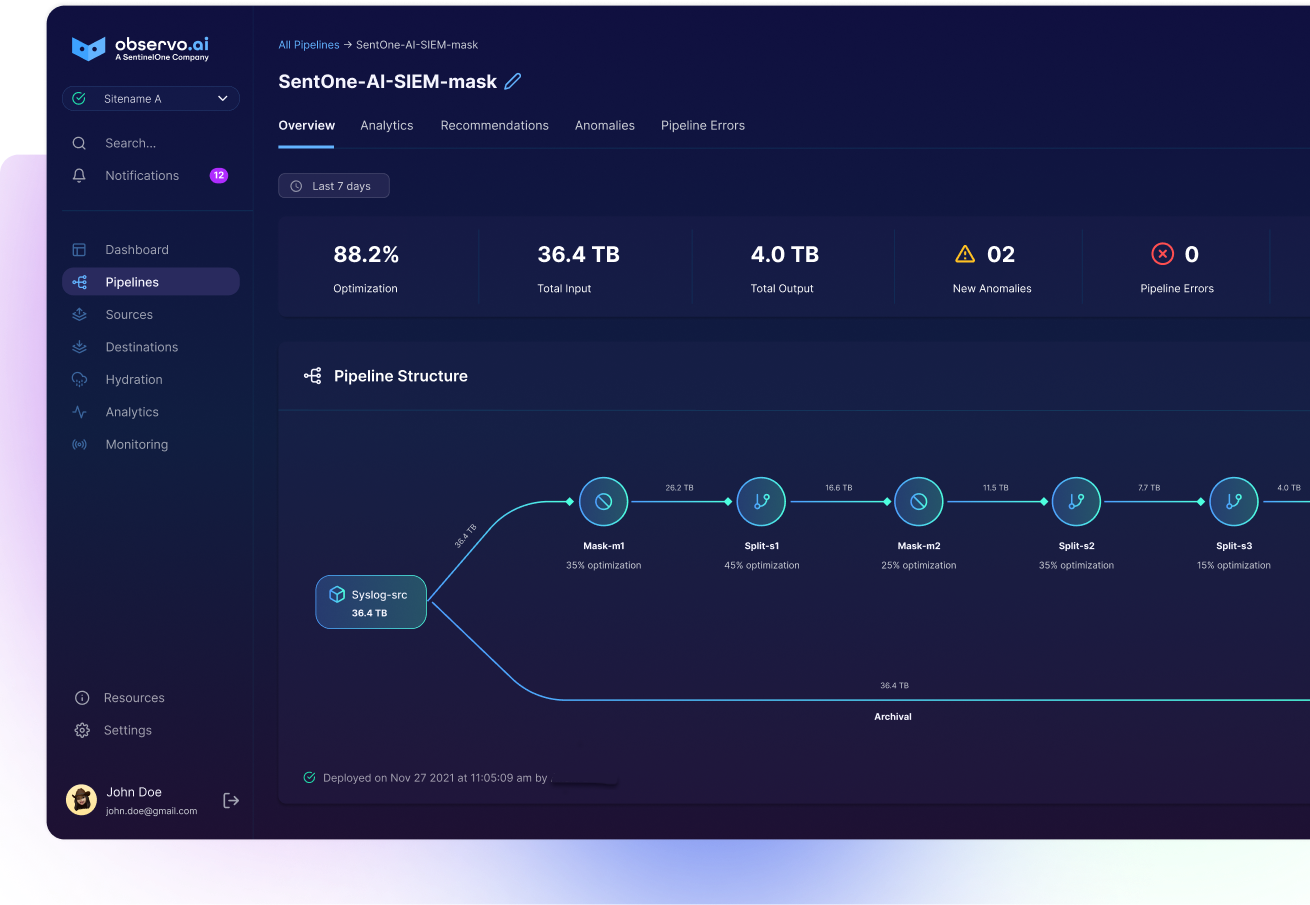
Built in Rust and Golang, Observo AI is designed for high performance and scalability, capable of handling the data volumes generated by the world’s largest financial institutions. A visual drag-and-drop interface, combined with the Orion AI agent, helps teams design, refine, and continuously improve pipelines without needing a large specialized engineering team. Pattern detection and data insights highlight emerging trends and surface opportunities for deeper optimization, helping security teams stay ahead of evolving threats and clearing out additional noisy events.
Observo AI also plays a direct role in protecting sensitive data. It can automatically identify PII in unexpected locations and apply masking or hashing in the data stream. For compliance and long-term retention, Observo AI can build data lakes in a customer’s own cloud or on premises storage, or route data to platform data lakes such as SentinelOne’s Singularity Data Lake. When an incident occurs, relevant data can be rehydrated quickly and sent to SIEMs and other tools on-demand, supporting thorough and timely breach response.
A Real-World Success Story
A large U.S. retail bank provides a good example of how this comes together in practice. Experiencing rapidly growing telemetry volumes, rising SIEM costs, and SOC overload after a security incident, the bank modernized its security data architecture with Observo AI at the core. In just a few months, they onboarded more than 20 data sources and built dozens of real time pipelines. Observo AI optimized over 70 percent of their log volume before it reached the SIEM, reducing noise while improving detection and response. They also created a full-fidelity data lake for compliance and long term investigations, giving them both better visibility today and stronger readiness for tomorrow’s audits and incident investigations.
For financial services organizations, curating security data is no longer optional. It is the only way to balance comprehensive visibility, fast detection, and regulatory compliance while managing costs. A modern security data pipeline makes it possible to see more, respond faster, and stay aligned with the strict standards of this industry.
If you are struggling with rising data volumes, alert fatigue, or compliance pressures, it may be time to rethink how your security data is curated. Schedule a demo to see how Observo AI can help you turn overwhelming telemetry into clear, actionable insight while meeting the unique demands of financial services.